Topwaters are among the most exciting baits you can fish for bass. Besides, topwaters are often very productive and can sometimes out-fish other techniques. In general, topwaters are most effective in warm to cool water, while slower, deeper baits such as jigs and worms are more effective in extremely cold and extremely hot water. If the water temperature is above 55 degrees, a topwater should be the first thing you throw in the morning. Topwaters are most effective in the early morning, late evening and during the calm before an approaching storm.
| Poppers | Attract bass with a gurgling and popping sound on the water's surface. Poppers should be retrieved in a series of starts and stops.Cast the lure out and let it rest a few minutes. Then retrieve it a few feet and let it rest again. The popping and gurgling will gain the fish's attention. The strike usually occurs when the lure is at rest. Fish them around weedlines, stumps, and shorelines. Experiment with retrieves as bass will want it fast one day, and very slow the next.
.jpg)
|
| StickBaits | Have no action of their own and require the fisherman's skill to make them perform maneuvers such as "walking the dog." These baits work well in open water, and around boat docks, tree lines, stump rows, etc. The most popular stick bait is the Zara Spook, and for good reasons. This bait has been catching largemouth and smallmouth alike for decades, often two at a time! It calls in fish from as deep as 25 feet and works under a variety of conditions. It works best during the summer and can be fished all day. The most productive colors all have one thing in common: a white belly. Tie the lure on using a large snap.
The most popular retrieve is 'walking the dog'. It takes some practice to achieve the proper jerk, pause, jerk cadence to walk the dog. It helps to have someone who has mastered the technique show you. You may have to keep the rod tip up the first 10 feet or so on long casts, then lower the tip and work it back in. If a fish misses it, keep going with the cadence - they'll come back and hit it again.

|
| Buzzbaits |
They are similar to spinnerbaits but are designed to be fished on top. Fish them right across logjams, submerged weeds, sparse grass, etc. Buzzbaits produce best from mid-spring to mid-fall when water temperature is above 65 degrees. They can be fished in, around, through and over cover due to its shape and design. They also produce best with a slow, erratic presentation.
- Add a trailer hook when short strikes occur, provided the terrain will permit.
- For better casting accuracy, point the rod tip towards where you want the lure to land and stop the spool. The lure will tighten the line and land. This will enable you to get the bait 'on plane' sooner.
- Change retrieve speeds, which will cause an erratic cripple sound.
- To improve your strike-catch ratio, set the hook by feel, rather than by sight.
- To increase your odds, make several casts to the same areas.
- Buzzbaits with clappers attached work best over heavy vegetation.
|
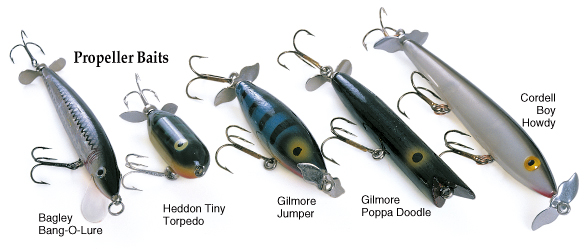
| Propbaits | Create a disturbance when jerked slightly. They work best when the water temperature is above 60 degrees. Work close to cover on heavy tackle or off long points on drop-offs on lighter tackle. Examples of propbaits include the Wood Chopper, Devils Horse, and Torpedo baits. Of these baits, the Devil's Horse in black/white and yellow perch colors is the most popular. Bend the front blades more on a Devils Horse, this will keep it from turning on its side during the retrieve.
Tie directly to the bait and let it sit for awhile after casting it out before starting a twitching retrieve back to the boat. In calm water use a slow, quiet retrieve. In choppy water use a noisy retrieve.
|
| JerkBaits | Use jerkbaits anytime the water temperature is above 55 degrees. By far the most popular jerkbait is the #13 Rapala floating minnow in silver/black for clear water or gold/black for dingy water. Use the Rapala in shallow water anytime the water temperature is above 55 degrees. Hook a snap onto it and tie it on using 6-8 pound test and spinning gear on a 6 1/2 foot medium-light action rod. Don't use heavy line as it will ruin the bait's action.
Cast it out and let it sit until the rings of water disappear, then begin a twitch, twitch, pause retrieve, making sure the bait never breaks the surface. Experiment with erratic retrieves to find what works best for that day. Another technique is the 'shaking' method: make it quiver in place by lifting your line up until you are just in contact with the bait, then shake the rod tip.
|




It's very effective fishing lures. soft & smooth fishing lures are very important for bass fishing.
ReplyDeleteThis comment has been removed by the author.
ReplyDeleteExcellent content. Click Best Crankbaits for Bass to get a discount on the best bass fishing lures.
ReplyDelete